
DAUM AND MAJORELLE
At the turn of the 20th century, Nancy (northeastern France) emerged as a prominent centre for the redefinition of the decorative arts in Europe. In the aftermath of the Franco-Prussian War, the region became a meeting place for French artists, designers, and craftsmen committed to forging a distinctly modern decorative language. This movement, later known as the École de Nancy (formally established in 1901) played a central role in the development of Art Nouveau in France.
Daum Nancy (a crystal studio taken over in 1878 by Jean Daum and his sons, Auguste and Antonin), rose to prominence during the 1900s through technical innovation in glassmaking, including the development of pâte de verre and advances in acid-etched and cameo glass. Under the leadership of Antonin, the firm embraced Art Nouveau’s emphasis on nature, material experimentation, and craftsmanship, while still supporting large-scale production.
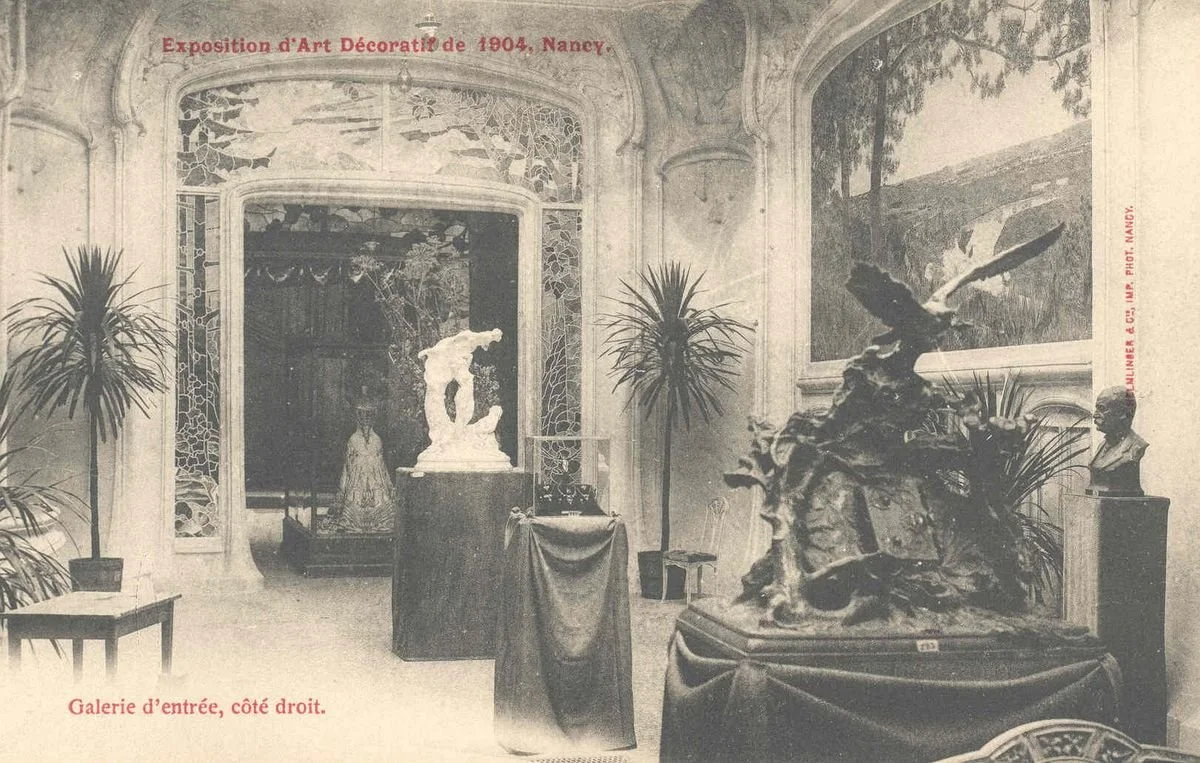
Exhibition of École de Nancy, Galerie Poirel, 1904
Louis Majorelle (1859 - 1926), one of the leading figures of the École de Nancy, was instrumental in redefining furniture and metalwork for the modern age. Trained as a cabinetmaker, he expanded his practice to include architectural ironwork and lighting, bringing a sense of form and construction to the movement’s vocabulary.


The collaboration between Daum and Majorelle was characteristic of the École de Nancy’s integrated approach to design. Rather than treating glass, metal, and furniture as separate disciplines, their partnerships fused materials and techniques into unified works that balanced natural inspiration with structural clarity.
Their collaboration often combined hand-blown glass with wrought iron frameworks, producing a striking contrast between materials. The glass achieved remarkable depth and colour, while the ironwork framed the glass with geometric patterns, providing structure and form. These collaborations signalled a transition from the sinuous, botanical language of Art Nouveau toward the more ordered, geometric aesthetic that would later define Art Deco.
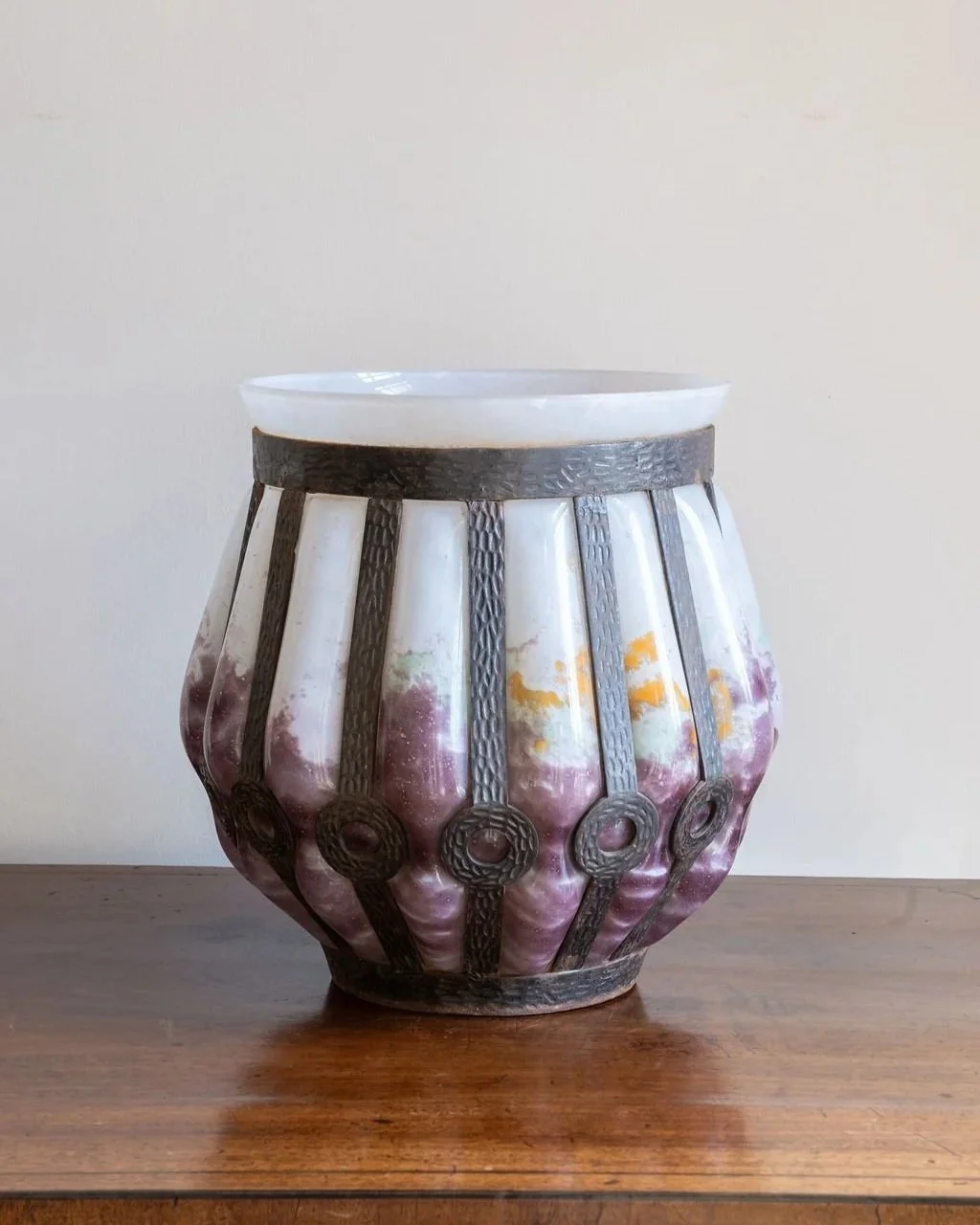
A large blown glass and wrought iron vase, in the manner of the collaboration between Daum Nancy and Louis Majorelle.
Small chip to the neck.
30.5cm H x 24.5cm D.